
Project
Kunst.Werk.Stein.Schlag. IV
(KWSS IV)
Kunst.Werk.Stein.Schlag (Art.Work.Stone.Hit) is a kinetic artwork combining found Chinese Scholar rocks with custom-made electromechanical devices. It transforms traditional Gongshi scholar's stones—Taihu rocks shaped by water over millennia— from contemplative objects into activated bodies, producing industrial mining sounds that break cultural silence. Strapped with machining belts and held by 3D-printed armatures, the object traverse from inanimate geological formations to animate characters, exploring morphology as an ongoing dialogue between geological time, cultural memory, and technological intervention. The work invites recontextualization, exposing how interpretive frameworks decode materiality and temporality across cultures.
KWSS is an installation at the intersection of Chinese cultural traditions and contemporary digital fabrication. It reinterprets morphology not as the study of static forms, but as an ongoing dialogue between geological forces, cultural memory, and technological intervention. . Central to this work are Gongshi, or scholar's stones—objects with profound significance in Chinese cultural history. The rocks used are Taihu stones, one of the four classical Chinese scholar rocks. Submerged in water for years, their porous material is slowly washed and perforated by natural movement, creating intricate holes and forms. These geological formations serve as objects of contemplation and reflection, portals into deep time itself. In Chinese cultural context, their value lies not in artifice but in geological authenticity, elevated to objects of philosophical contemplation. In KWSS, we break the silence of these cultural objects.
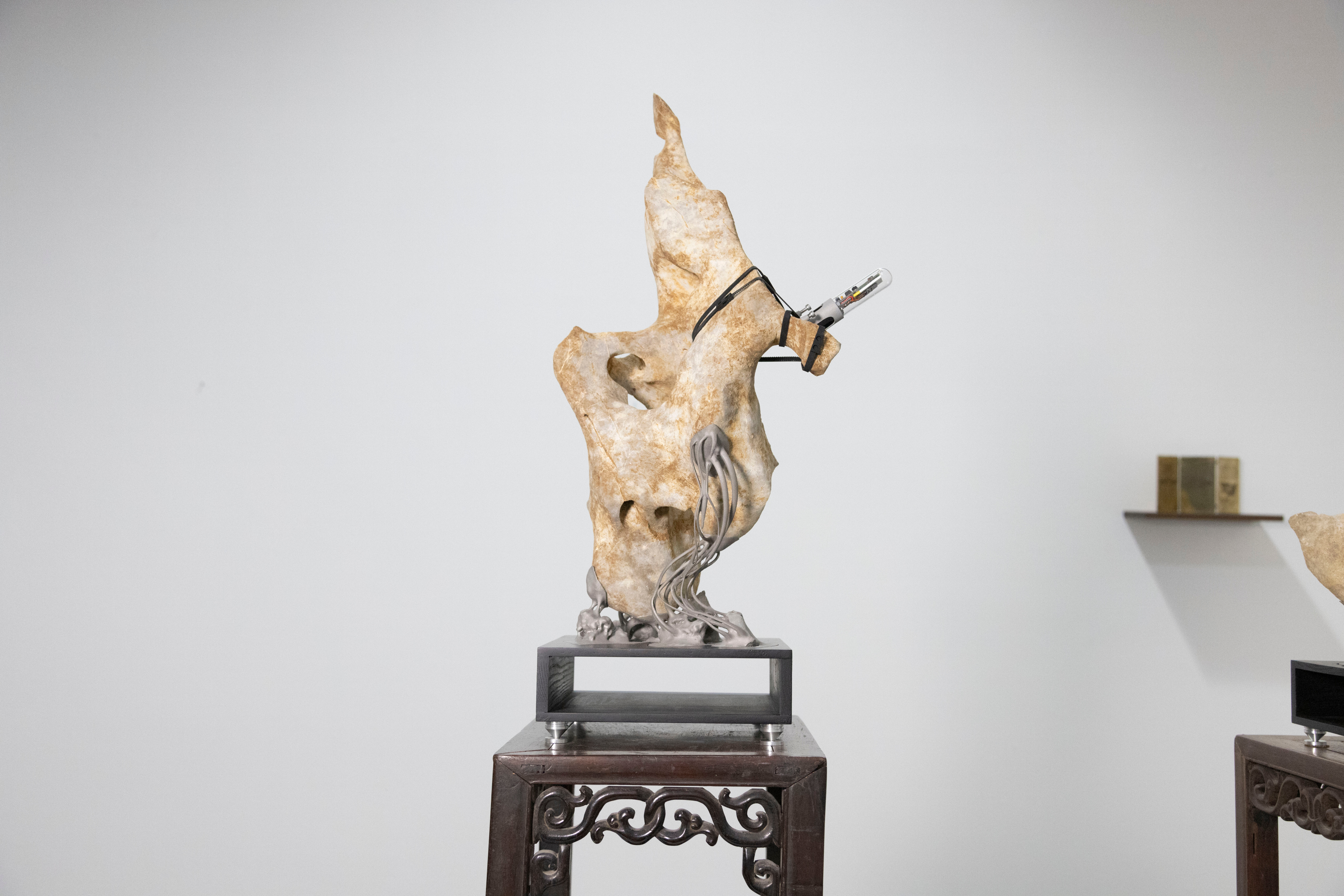
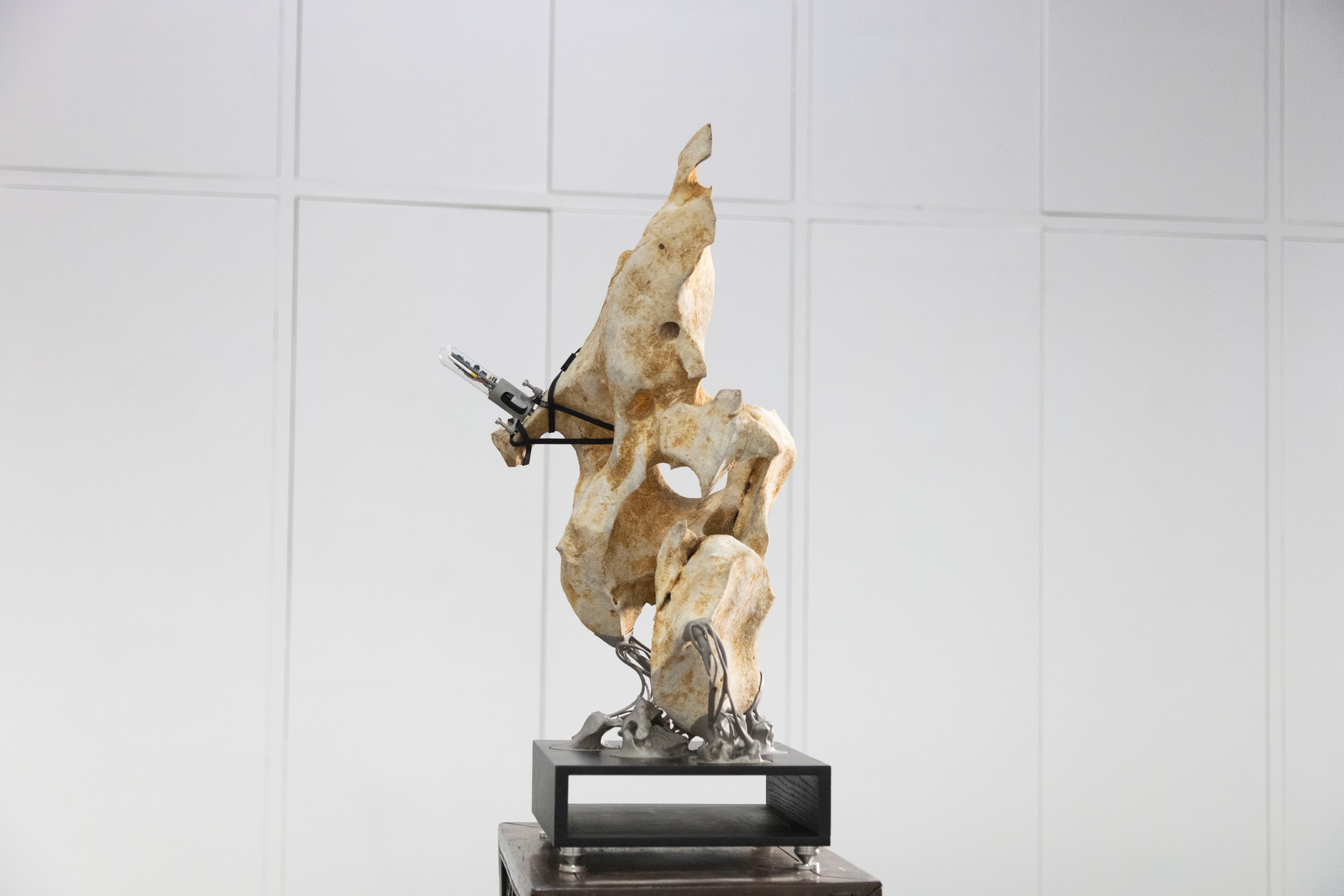
Rather than extending contemplation, we actualize it differently: electromechanical devices—artificial agitators—continuously strike the rocks. These autonomous chisels suggest how technology transforms into another uncontrollable force for which we remain responsible. . The devices use solenoids to randomly strike the rock surface with metal plungers, producing sounds reminiscent of the sound of mining. The agitators are strapped onto the rocks using industrial machining belts, crossing narrative contexts from naturally eroded to artificially carved forms. The black straps transform the rocks from inanimate objects into bodies and characters. These bodies are held by 3D-printed stainless-steel armatures, reinterpreting the traditional wooden bases custom-made for scholar rocks. Where traditional bases amplify natural beauty, in KWSS they connect rocks to sound-resonating platforms.
The title itself demands recontextualization. In German, the last word in a compound determines meaning.Kunst.Werk.Stein.Schlag encompasses four components—Art.Work.Stone.Hit— each meaningful alone yet, combined like Chinese characters, they create overarching complexity beyond their parts. Through deliberate punctuation, we invite reflection on conceptual frameworks and their permutations. . KWSS transforms the rocks' stillness through technological intervention that feels strangely organic within Chinese philosophical context. This isn't contradiction but continuation. In Ne0 Confucian thought, Li describes patterns existing simultaneously at micro and macro scales, in natural and cultural formations alike. There is no fundamental separation between technological and natural, ancient and contemporary. These rocks represent millions of years of geological formation, yet feel profoundly present and ongoing—not frozen moments but active processes we witness.
KWSS functions as investigation and an invitation to explore what stones are, how they form, what they mean across cultural contexts. These objets trouvés recontextualized expose how our culturally specific patterns of interpretation sometimes fail to decode what we see, creating not frustration but generosity—a rare glimpse into alternative ways of understanding materiality, temporality, and the relationship between human creation and natural process. . KWSS is about transformation without hierarchy, patterns connecting microscopic and cosmic scales, time made comprehensible through objects simultaneously containing deep history and active becoming. The artwork forces us to accept responsibility for how we carve the world—no longer just a source of inspiration, but a scene of intervention, extending the philosophical reflection induced by scholar rocks.
#Installation
Publications


ADDRESS
School of Creative Media,
City University of Hong Kong, 18 Tat Hong Avenue, Kowloon Tong, Hong Kong
CONTACT
info@awesomelab.studio
SOCIAL
Youtube
Project
Kunst.Werk.Stein.Schlag. IV
(KWSS IV)
Kunst.Werk.Stein.Schlag (Art.Work.Stone.Hit) is a kinetic artwork combining found Chinese Scholar rocks with custom-made electromechanical devices. It transforms traditional Gongshi scholar's stones—Taihu rocks shaped by water over millennia— from contemplative objects into activated bodies, producing industrial mining sounds that break cultural silence. Strapped with machining belts and held by 3D-printed armatures, the object traverse from inanimate geological formations to animate characters, exploring morphology as an ongoing dialogue between geological time, cultural memory, and technological intervention. The work invites recontextualization, exposing how interpretive frameworks decode materiality and temporality across cultures.
KWSS is an installation at the intersection of Chinese cultural traditions and contemporary digital fabrication. It reinterprets morphology not as the study of static forms, but as an ongoing dialogue between geological forces, cultural memory, and technological intervention. . Central to this work are Gongshi, or scholar's stones—objects with profound significance in Chinese cultural history. The rocks used are Taihu stones, one of the four classical Chinese scholar rocks. Submerged in water for years, their porous material is slowly washed and perforated by natural movement, creating intricate holes and forms. These geological formations serve as objects of contemplation and reflection, portals into deep time itself. In Chinese cultural context, their value lies not in artifice but in geological authenticity, elevated to objects of philosophical contemplation. In KWSS, we break the silence of these cultural objects.
Rather than extending contemplation, we actualize it differently: electromechanical devices—artificial agitators—continuously strike the rocks. These autonomous chisels suggest how technology transforms into another uncontrollable force for which we remain responsible. . The devices use solenoids to randomly strike the rock surface with metal plungers, producing sounds reminiscent of the sound of mining. The agitators are strapped onto the rocks using industrial machining belts, crossing narrative contexts from naturally eroded to artificially carved forms. The black straps transform the rocks from inanimate objects into bodies and characters. These bodies are held by 3D-printed stainless-steel armatures, reinterpreting the traditional wooden bases custom-made for scholar rocks. Where traditional bases amplify natural beauty, in KWSS they connect rocks to sound-resonating platforms.
The title itself demands recontextualization. In German, the last word in a compound determines meaning.Kunst.Werk.Stein.Schlag encompasses four components—Art.Work.Stone.Hit— each meaningful alone yet, combined like Chinese characters, they create overarching complexity beyond their parts. Through deliberate punctuation, we invite reflection on conceptual frameworks and their permutations. . KWSS transforms the rocks' stillness through technological intervention that feels strangely organic within Chinese philosophical context. This isn't contradiction but continuation. In Ne0 Confucian thought, Li describes patterns existing simultaneously at micro and macro scales, in natural and cultural formations alike. There is no fundamental separation between technological and natural, ancient and contemporary. These rocks represent millions of years of geological formation, yet feel profoundly present and ongoing—not frozen moments but active processes we witness.
KWSS functions as investigation and an invitation to explore what stones are, how they form, what they mean across cultural contexts. These objets trouvés recontextualized expose how our culturally specific patterns of interpretation sometimes fail to decode what we see, creating not frustration but generosity—a rare glimpse into alternative ways of understanding materiality, temporality, and the relationship between human creation and natural process. . KWSS is about transformation without hierarchy, patterns connecting microscopic and cosmic scales, time made comprehensible through objects simultaneously containing deep history and active becoming. The artwork forces us to accept responsibility for how we carve the world—no longer just a source of inspiration, but a scene of intervention, extending the philosophical reflection induced by scholar rocks.
#Installation
2025
Publications


ADDRESS
School of Creative Media, City University of Hong Kong, 18 Tat Hong Avenue, Kowloon Tong, Hong Kong
CONTACT
info@awesomelab.studio
SOCIAL
Youtube
Project
Kunst.Werk.Stein.Schlag. IV
(KWSS IV)
Kunst.Werk.Stein.Schlag (Art.Work.Stone.Hit) is a kinetic artwork combining found Chinese Scholar rocks with custom-made electromechanical devices. It transforms traditional Gongshi scholar's stones—Taihu rocks shaped by water over millennia— from contemplative objects into activated bodies, producing industrial mining sounds that break cultural silence. Strapped with machining belts and held by 3D-printed armatures, the object traverse from inanimate geological formations to animate characters, exploring morphology as an ongoing dialogue between geological time, cultural memory, and technological intervention. The work invites recontextualization, exposing how interpretive frameworks decode materiality and temporality across cultures.
KWSS is an installation at the intersection of Chinese cultural traditions and contemporary digital fabrication. It reinterprets morphology not as the study of static forms, but as an ongoing dialogue between geological forces, cultural memory, and technological intervention. . Central to this work are Gongshi, or scholar's stones—objects with profound significance in Chinese cultural history. The rocks used are Taihu stones, one of the four classical Chinese scholar rocks. Submerged in water for years, their porous material is slowly washed and perforated by natural movement, creating intricate holes and forms. These geological formations serve as objects of contemplation and reflection, portals into deep time itself. In Chinese cultural context, their value lies not in artifice but in geological authenticity, elevated to objects of philosophical contemplation. In KWSS, we break the silence of these cultural objects.
Rather than extending contemplation, we actualize it differently: electromechanical devices—artificial agitators—continuously strike the rocks. These autonomous chisels suggest how technology transforms into another uncontrollable force for which we remain responsible. . The devices use solenoids to randomly strike the rock surface with metal plungers, producing sounds reminiscent of the sound of mining. The agitators are strapped onto the rocks using industrial machining belts, crossing narrative contexts from naturally eroded to artificially carved forms. The black straps transform the rocks from inanimate objects into bodies and characters. These bodies are held by 3D-printed stainless-steel armatures, reinterpreting the traditional wooden bases custom-made for scholar rocks. Where traditional bases amplify natural beauty, in KWSS they connect rocks to sound-resonating platforms.
The title itself demands recontextualization. In German, the last word in a compound determines meaning.Kunst.Werk.Stein.Schlag encompasses four components—Art.Work.Stone.Hit— each meaningful alone yet, combined like Chinese characters, they create overarching complexity beyond their parts. Through deliberate punctuation, we invite reflection on conceptual frameworks and their permutations. . KWSS transforms the rocks' stillness through technological intervention that feels strangely organic within Chinese philosophical context. This isn't contradiction but continuation. In Ne0 Confucian thought, Li describes patterns existing simultaneously at micro and macro scales, in natural and cultural formations alike. There is no fundamental separation between technological and natural, ancient and contemporary. These rocks represent millions of years of geological formation, yet feel profoundly present and ongoing—not frozen moments but active processes we witness.
KWSS functions as investigation and an invitation to explore what stones are, how they form, what they mean across cultural contexts. These objets trouvés recontextualized expose how our culturally specific patterns of interpretation sometimes fail to decode what we see, creating not frustration but generosity—a rare glimpse into alternative ways of understanding materiality, temporality, and the relationship between human creation and natural process. . KWSS is about transformation without hierarchy, patterns connecting microscopic and cosmic scales, time made comprehensible through objects simultaneously containing deep history and active becoming. The artwork forces us to accept responsibility for how we carve the world—no longer just a source of inspiration, but a scene of intervention, extending the philosophical reflection induced by scholar rocks.
#Installation
2025
Publications


ADDRESS
School of Creative Media, City University of Hong Kong, 18 Tat Hong Avenue, Kowloon Tong, Hong Kong
CONTACT
info@awesomelab.studio
SOCIAL
Youtube