
Project
Sternwerk
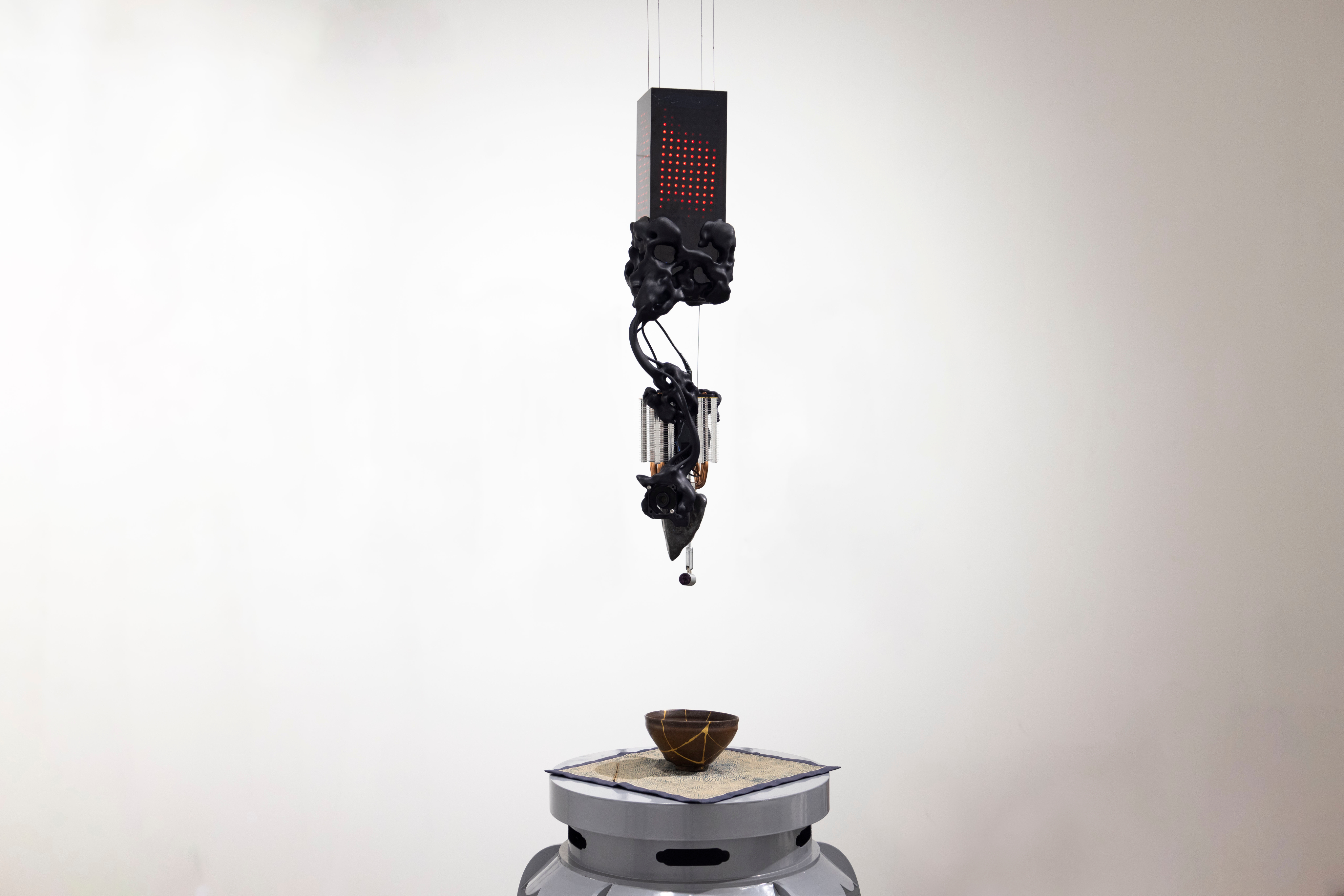
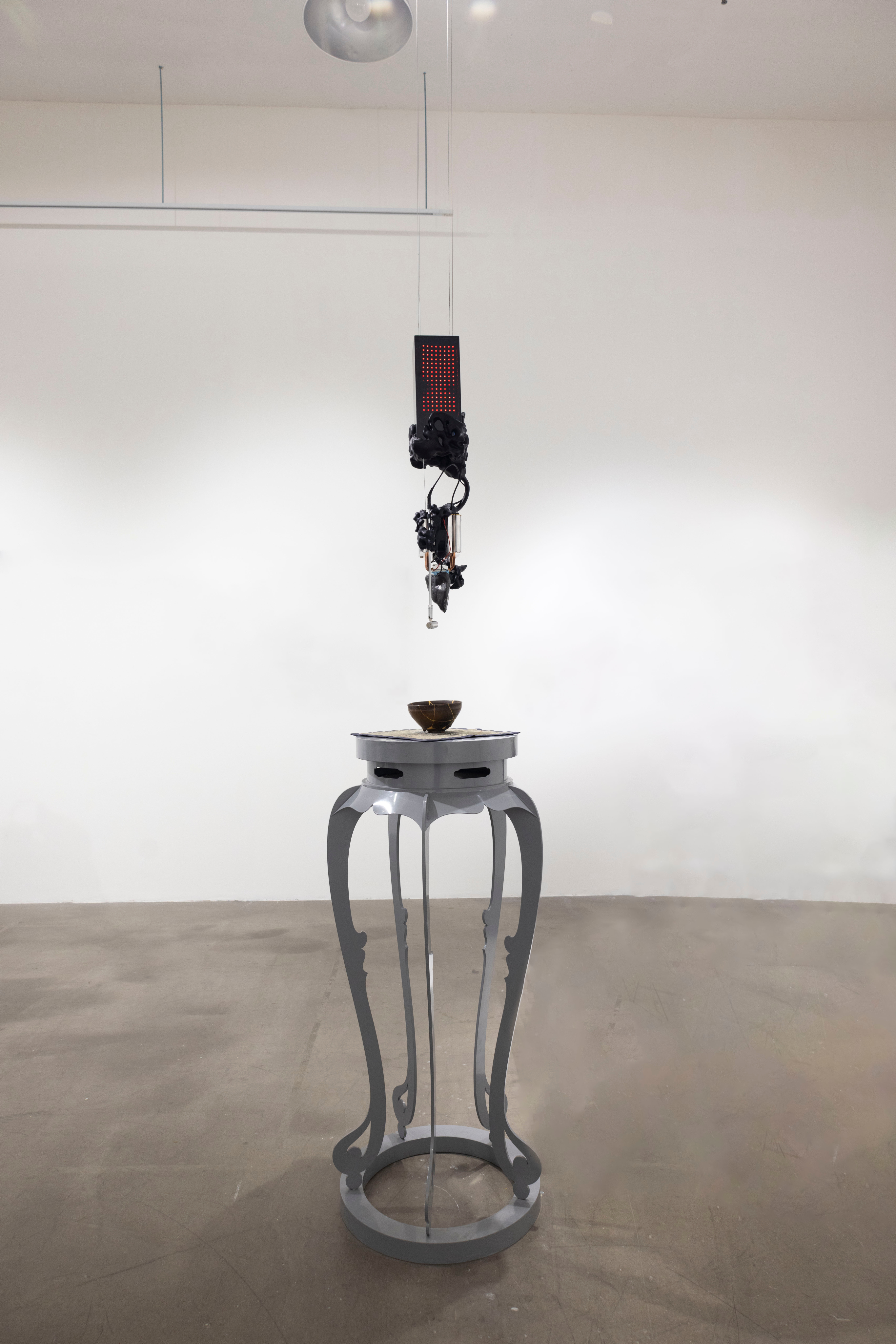
Sternwerk is an interactive installation creating meaning through the constellation of a meteorite (deep time), a simulation (Conway's Game of Life), and human presence. The meteorit, acting as a heat sink for the computation, becomes condenser for human breath. As each drop falls, amplified by sound, it resets the cellular automata simulation, perpetually restarting a fragile universe. This cyclical process transforms our ephemeral breath into a microcosmic echo of vast temporal scales. The residue carried by each drop becomes a material archive, a humble counter-monument to deep time and human encounters with the cosmic.
Sternwerk is a constructed German word merging "Stern" (star, often used poetically to describe celestial bodies) and "Werk" (which carries multiple meanings in German). "Werk" can mean a factory or assembly line—an industrial process—or it can mean work, related to the concept of the artwork. We created this deliberate ambiguity to articulate an unstable, generative in-between space—a conceptual context where meanings oscillate and familiar elements are transmuted and materialized through production. The work is an installation that builds meaning through the relationship between three irreducible agents. The first is a meteorite, a cosmic fragment bearing the memory of deep time. The second is a computational simulation (Conway's Game of Life) enacting emergent complexity from simple, deterministic rules. The third is us, human beings reduced to observers. In this constellation, the meteorite—an ancient witness—serves as a heatsink for a humanmade machine: a microcontroller running the fragile, miniature universe of cellular automata. Between the intangible computational simulation and the material reality of the meteorite stands the human, trapped between figments of its own imagination and a cosmic reality.
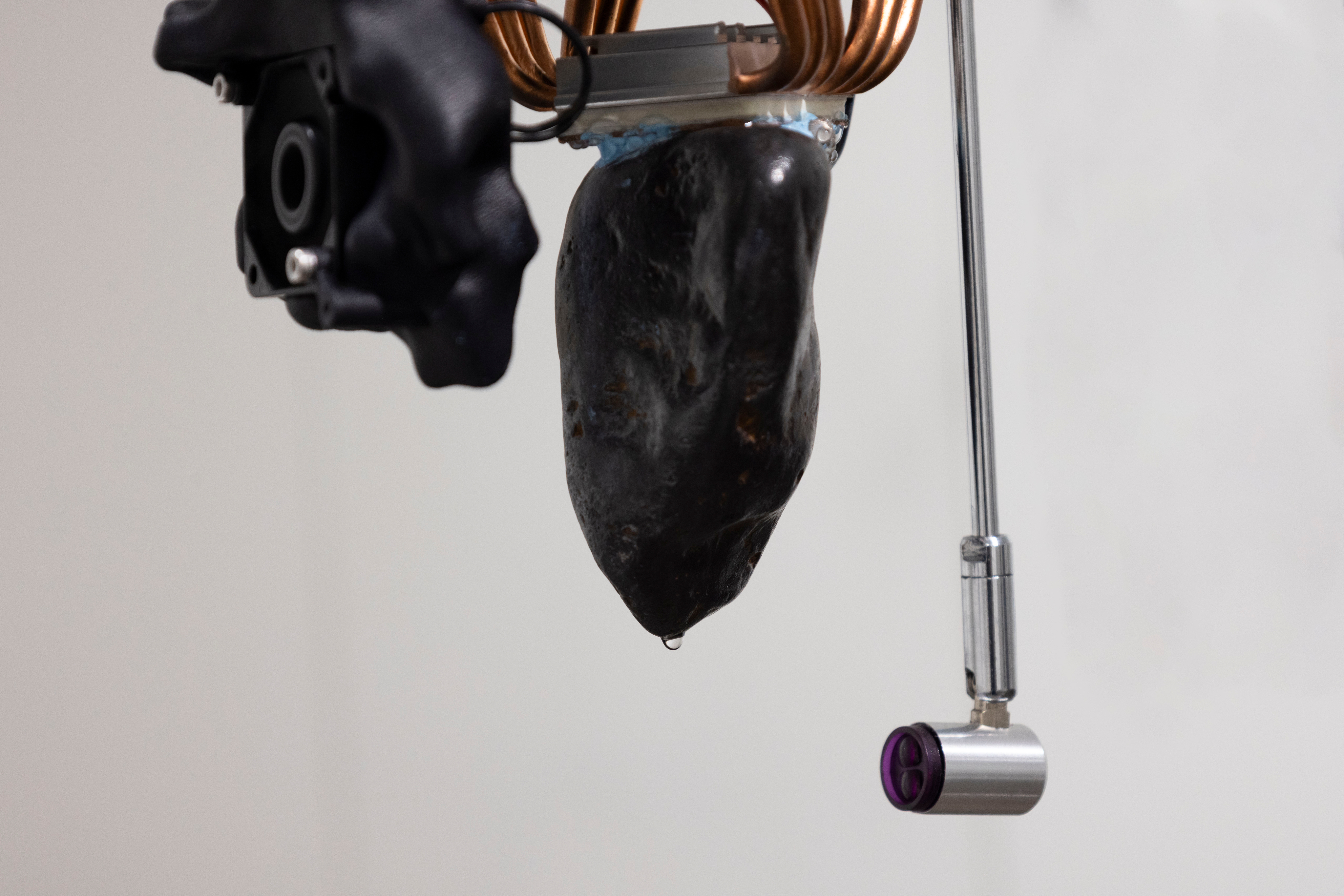
Human presence between these cosmic forces—its actual sign of life, breathing—materializes the computational process on the meteorite's surface as condensed droplets. Gravity slowly pulls them across the meteorite's surface until they fall. This act, our materialized but passive presence, resets the computational process, erasing every trace of artificial life and restarting the simulation. The work restarts, seemingly meaningless—a universe perpetually destroyed and reborn each time a single drop of water, condensed from the breath of a random visitor, detaches from the meteorite's cold surface. This cyclical destruction and rebirth echoes ancient Hindu cosmogony, where the universe itself breathes in vast cosmic cycles called kalpas. In this tradition, the god Brahma's breath marks the rhythm of creation and dissolution—each inhalation drawing the cosmos into being, each exhalation returning it to a primordial void. A single day of Brahma spans 4.32 billion years, followed by an equally long night of dissolution.
Our human breath—condensing, falling, resetting the simulation—becomes a microcosmic mirror of these incomprehensible temporal rhythms. . The falling drop, amplified sonically at the moment of impact, marks both an end and a beginning. It punctuates an endless loop where the cosmic, the simulated, and human breath collide. Yet a trace persists: each drop, transformed by its passage over the meteorite's iron-rich surface, carries infinitesimal stardust into a collecting basin below. This accumulating residue—this slow sedimentation of the ephemeral— becomes a material archive of countless individual encounters, a humble countermonument to deep
Born from intense dialogues confronting the profound incapacity of the human mind to grasp cosmic forces and temporal scales spanning billions of years, Sternwerk functions as a perceptual instrument. It compels a recalibration of significance, exposing the myopia of technological acceleration and the hubris inherent in human exploration of the cosmic. time written in water and iron.
#Installation
Publications


ADDRESS
School of Creative Media,
City University of Hong Kong, 18 Tat Hong Avenue, Kowloon Tong, Hong Kong
CONTACT
info@awesomelab.studio
SOCIAL
Youtube
Project
Sternwerk
Sternwerk is an interactive installation creating meaning through the constellation of a meteorite (deep time), a simulation (Conway's Game of Life), and human presence. The meteorit, acting as a heat sink for the computation, becomes condenser for human breath. As each drop falls, amplified by sound, it resets the cellular automata simulation, perpetually restarting a fragile universe. This cyclical process transforms our ephemeral breath into a microcosmic echo of vast temporal scales. The residue carried by each drop becomes a material archive, a humble counter-monument to deep time and human encounters with the cosmic.
Sternwerk is a constructed German word merging "Stern" (star, often used poetically to describe celestial bodies) and "Werk" (which carries multiple meanings in German). "Werk" can mean a factory or assembly line—an industrial process—or it can mean work, related to the concept of the artwork. We created this deliberate ambiguity to articulate an unstable, generative in-between space—a conceptual context where meanings oscillate and familiar elements are transmuted and materialized through production. The work is an installation that builds meaning through the relationship between three irreducible agents. The first is a meteorite, a cosmic fragment bearing the memory of deep time. The second is a computational simulation (Conway's Game of Life) enacting emergent complexity from simple, deterministic rules. The third is us, human beings reduced to observers. In this constellation, the meteorite—an ancient witness—serves as a heatsink for a humanmade machine: a microcontroller running the fragile, miniature universe of cellular automata. Between the intangible computational simulation and the material reality of the meteorite stands the human, trapped between figments of its own imagination and a cosmic reality.
Human presence between these cosmic forces—its actual sign of life, breathing—materializes the computational process on the meteorite's surface as condensed droplets. Gravity slowly pulls them across the meteorite's surface until they fall. This act, our materialized but passive presence, resets the computational process, erasing every trace of artificial life and restarting the simulation. The work restarts, seemingly meaningless—a universe perpetually destroyed and reborn each time a single drop of water, condensed from the breath of a random visitor, detaches from the meteorite's cold surface. This cyclical destruction and rebirth echoes ancient Hindu cosmogony, where the universe itself breathes in vast cosmic cycles called kalpas. In this tradition, the god Brahma's breath marks the rhythm of creation and dissolution—each inhalation drawing the cosmos into being, each exhalation returning it to a primordial void. A single day of Brahma spans 4.32 billion years, followed by an equally long night of dissolution.
Our human breath—condensing, falling, resetting the simulation—becomes a microcosmic mirror of these incomprehensible temporal rhythms. . The falling drop, amplified sonically at the moment of impact, marks both an end and a beginning. It punctuates an endless loop where the cosmic, the simulated, and human breath collide. Yet a trace persists: each drop, transformed by its passage over the meteorite's iron-rich surface, carries infinitesimal stardust into a collecting basin below. This accumulating residue—this slow sedimentation of the ephemeral— becomes a material archive of countless individual encounters, a humble countermonument to deep
Born from intense dialogues confronting the profound incapacity of the human mind to grasp cosmic forces and temporal scales spanning billions of years, Sternwerk functions as a perceptual instrument. It compels a recalibration of significance, exposing the myopia of technological acceleration and the hubris inherent in human exploration of the cosmic. time written in water and iron.
#Installation
2025
Publications


ADDRESS
School of Creative Media, City University of Hong Kong, 18 Tat Hong Avenue, Kowloon Tong, Hong Kong
CONTACT
info@awesomelab.studio
SOCIAL
Youtube
Project
Sternwerk
Sternwerk is an interactive installation creating meaning through the constellation of a meteorite (deep time), a simulation (Conway's Game of Life), and human presence. The meteorit, acting as a heat sink for the computation, becomes condenser for human breath. As each drop falls, amplified by sound, it resets the cellular automata simulation, perpetually restarting a fragile universe. This cyclical process transforms our ephemeral breath into a microcosmic echo of vast temporal scales. The residue carried by each drop becomes a material archive, a humble counter-monument to deep time and human encounters with the cosmic.
Sternwerk is a constructed German word merging "Stern" (star, often used poetically to describe celestial bodies) and "Werk" (which carries multiple meanings in German). "Werk" can mean a factory or assembly line—an industrial process—or it can mean work, related to the concept of the artwork. We created this deliberate ambiguity to articulate an unstable, generative in-between space—a conceptual context where meanings oscillate and familiar elements are transmuted and materialized through production. The work is an installation that builds meaning through the relationship between three irreducible agents. The first is a meteorite, a cosmic fragment bearing the memory of deep time. The second is a computational simulation (Conway's Game of Life) enacting emergent complexity from simple, deterministic rules. The third is us, human beings reduced to observers. In this constellation, the meteorite—an ancient witness—serves as a heatsink for a humanmade machine: a microcontroller running the fragile, miniature universe of cellular automata. Between the intangible computational simulation and the material reality of the meteorite stands the human, trapped between figments of its own imagination and a cosmic reality.
Human presence between these cosmic forces—its actual sign of life, breathing—materializes the computational process on the meteorite's surface as condensed droplets. Gravity slowly pulls them across the meteorite's surface until they fall. This act, our materialized but passive presence, resets the computational process, erasing every trace of artificial life and restarting the simulation. The work restarts, seemingly meaningless—a universe perpetually destroyed and reborn each time a single drop of water, condensed from the breath of a random visitor, detaches from the meteorite's cold surface. This cyclical destruction and rebirth echoes ancient Hindu cosmogony, where the universe itself breathes in vast cosmic cycles called kalpas. In this tradition, the god Brahma's breath marks the rhythm of creation and dissolution—each inhalation drawing the cosmos into being, each exhalation returning it to a primordial void. A single day of Brahma spans 4.32 billion years, followed by an equally long night of dissolution.
Our human breath—condensing, falling, resetting the simulation—becomes a microcosmic mirror of these incomprehensible temporal rhythms. . The falling drop, amplified sonically at the moment of impact, marks both an end and a beginning. It punctuates an endless loop where the cosmic, the simulated, and human breath collide. Yet a trace persists: each drop, transformed by its passage over the meteorite's iron-rich surface, carries infinitesimal stardust into a collecting basin below. This accumulating residue—this slow sedimentation of the ephemeral— becomes a material archive of countless individual encounters, a humble countermonument to deep
Born from intense dialogues confronting the profound incapacity of the human mind to grasp cosmic forces and temporal scales spanning billions of years, Sternwerk functions as a perceptual instrument. It compels a recalibration of significance, exposing the myopia of technological acceleration and the hubris inherent in human exploration of the cosmic. time written in water and iron.
#Installation
2025
Publications


ADDRESS
School of Creative Media, City University of Hong Kong, 18 Tat Hong Avenue, Kowloon Tong, Hong Kong
CONTACT
info@awesomelab.studio
SOCIAL
Youtube